

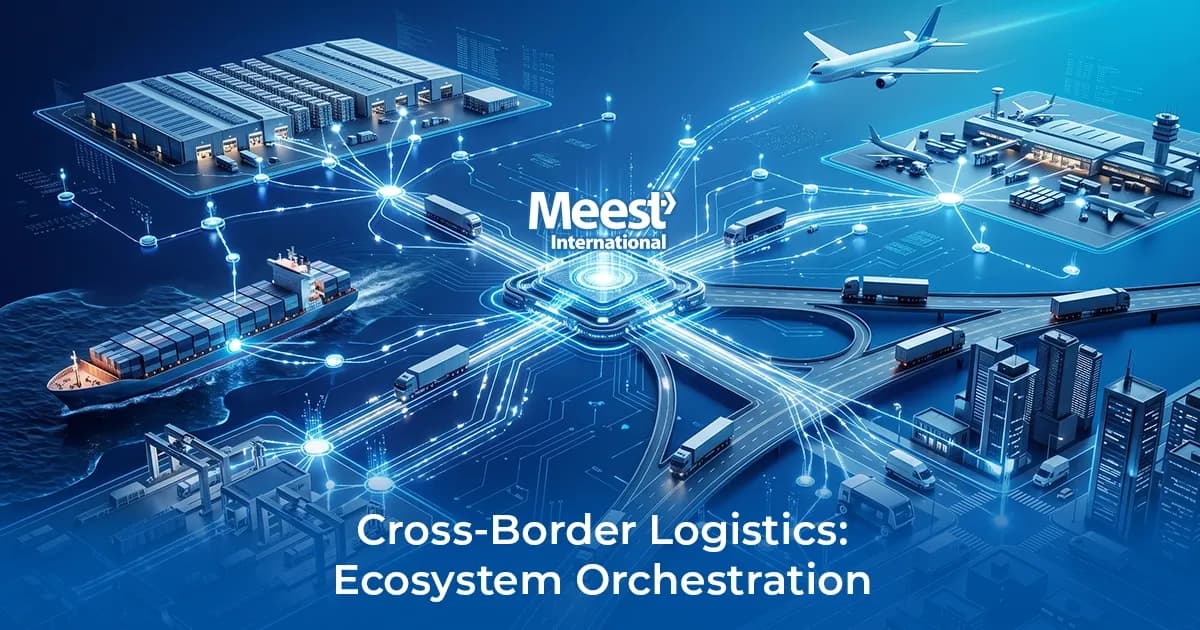
The competitive edge in cross-border logistics no longer belongs to companies with the most assets – it belongs to those that most effectively orchestrate a network of independent partners. Meest International exemplifies this shift, connecting carriers, fulfilment centres, customs systems, and last-mile providers into a single, seamless delivery chain.
For decades, logistics was a game of accumulation. The companies that won were the ones that owned more – more warehouses, more trucks, more routes, more infrastructure. Scale was the strategy, and ownership was the moat.
That logic made sense in a simpler era of trade. But cross-border logistics today operates across a fundamentally different terrain. International shipments move through multiple carriers, fulfilment centres, customs environments, and last-mile providers – often within a single transaction. No single company owns the entire chain. And increasingly, trying to is the wrong ambition entirely.
The new competitive advantage is not control. It is connection.
The Old Logic of Logistics: Scale Through Ownership
The infrastructure-first model of logistics was built on a straightforward premise: the more you own, the more you control; the more you control, the better your service. Vertical integration was seen as the path to reliability.
For domestic logistics, this held. Predictable volumes, consistent regulations, and familiar geography made ownership a viable differentiator. Carriers that invested heavily in assets – sortation facilities, proprietary fleets, owned warehouses – could offer speed and consistency that asset-light competitors struggled to match.
Cross-border trade, however, introduced a layer of complexity that ownership alone cannot resolve. Regulatory environments shift across borders. Consumer expectations vary by market. Last-mile infrastructure in one country bears little resemblance to another. The variables multiply faster than any single organisation can build infrastructure to address them.
How Cross-Border Logistics Has Changed
The structural shift in global trade over the past decade has been significant. E-commerce growth has driven a surge in cross-border parcel volumes, with consumers in Europe, Asia, and the Americas purchasing from international retailers at scale. According to the International Post Corporation, cross-border e-commerce now accounts for a growing share of total parcel traffic, with delivery expectations continuing to rise.
This growth has made one thing clear: the delivery chain is too complex and too geographically distributed for any single operator to own end-to-end.
An international shipment today might originate at a merchant's warehouse in Poland, pass through a consolidation hub, clear customs in a destination country, transfer to a regional carrier, and reach the end customer via a local delivery partner – all within a matter of days. Each step involves a different system, a different partner, and a different set of requirements.
The question for logistics operators is no longer "How much can we own?" It is "How well can we connect what already exists?"
The Shift: From Ownership to Ecosystem Orchestration
Ecosystem orchestration is a precise term for what modern cross-border logistics leadership actually looks like. Rather than building or acquiring every component of the delivery chain, orchestrators integrate across independent partners – connecting carriers, technology platforms, customs agents, fulfilment providers, and last-mile operators into a coherent, managed system.
The value does not come from controlling each node. It comes from making the nodes work together – efficiently, reliably, and with real-time visibility across the full journey.
This distinction matters for decision-makers evaluating logistics partners. An asset-heavy provider can offer depth within its own network. An orchestrator offers breadth across many networks, with the coordination layer that turns complexity into consistency.
The companies winning in cross-border logistics are not necessarily the largest. They are the ones that make complexity work as a single system.
What Ecosystem Orchestration Looks Like in Practice
Orchestration is not a passive capability. It requires deliberate investment in three areas:
Integration infrastructure. Connecting disparate systems – carrier APIs, customs platforms, warehouse management tools, tracking interfaces – into a unified data environment. Without this, visibility breaks down at every handoff point.
Partner governance. Managing a network of independent operators requires clear service standards, shared performance metrics, and the ability to route shipments dynamically based on real-time conditions. The orchestrator must be able to act on data, not just collect it.
End-to-end visibility. For B2B clients and end consumers alike, the ability to track a shipment across every leg of its journey – regardless of which partner is handling it – is now a baseline expectation. Orchestrators must provide this visibility even when they do not own the underlying infrastructure.
Together, these capabilities create a delivery experience that feels seamless to the client, even when it spans five countries and four different operators.
How Meest International Embodies This Approach
Meest International operates across more than 80 countries, managing cross-border shipments that pass through a complex web of carriers, customs authorities, fulfilment centres, and last-mile partners. Its model is built not on owning every component of that chain, but on connecting them effectively.
The Meest International approach centres on reliable integration – both technical and operational – with a global network of delivery partners. Rather than replicating local infrastructure in every market it serves, Meest International works with established regional operators, applying its coordination layer to ensure that shipments move consistently across borders, regardless of the local environment.
This positions Meest International not as a carrier in the traditional sense, but as a cross-border logistics orchestrator: a company whose primary value is the ability to make a fragmented international chain behave like a single, managed system.
For e-commerce retailers and logistics professionals evaluating partners for international expansion, this distinction is operationally significant. A partner that orchestrates effectively can adapt to new markets without requiring the client to manage multiple regional relationships independently. The complexity sits with the orchestrator – and the client receives a reliable, scalable service.
Meest International's MWL API integration framework reflects this philosophy directly, enabling partners to connect their own systems to Meest's network without rebuilding their existing infrastructure. Integration, not replacement, is the model.
In Modern Logistics, Success Is About Connection
The infrastructure ownership model served its era well. But the economics and complexity of modern cross-border logistics have shifted the basis of competition.
Decision-makers evaluating logistics partners today should ask not only what infrastructure a provider owns, but what ecosystem it can connect – and how effectively it manages that ecosystem in practice. The answers reveal more about a provider's actual capability than a list of owned assets ever could.
Meest International's approach demonstrates what effective orchestration looks like at scale: a global network, managed through integration, delivering consistency across a chain that no single operator could own outright.
The companies that thrive in cross-border logistics over the next decade will be those that master this model. Success, in the end, is not about control. It is about connection.
Frequently Asked Questions
What is ecosystem orchestration in logistics?
Ecosystem orchestration in logistics refers to the practice of integrating and coordinating independent partners – including carriers, fulfilment centres, customs agents, and last-mile providers – into a unified, managed delivery chain. Rather than owning each component, orchestrators focus on connecting them effectively to deliver consistent, end-to-end service.
Why is infrastructure ownership no longer enough for cross-border logistics?
Cross-border shipments now pass through multiple regulatory environments, carrier networks, and last-mile systems that no single company can own in full. The complexity of international trade requires coordination across independent partners, making integration and visibility more valuable than asset ownership alone.
What should businesses look for in a cross-border logistics partner?
Businesses should evaluate a partner's ability to integrate across a wide network of carriers and fulfilment providers, provide real-time end-to-end shipment visibility, manage partner performance consistently, and scale operations across new markets without requiring the client to manage multiple regional relationships independently.
How does Meest International support cross-border e-commerce at scale?
Meest International connects a global network of delivery partners across more than 80 countries, using an API integration framework – MWL – to enable seamless system connectivity. This allows e-commerce retailers and logistics operators to access reliable international delivery without rebuilding their own infrastructure in every market.
What is the difference between a traditional carrier and a logistics orchestrator?
A traditional carrier primarily delivers within its own owned network. A logistics orchestrator manages a broader ecosystem of independent partners, providing coordination, integration, and visibility across the full delivery chain – regardless of which operator is handling each leg of the shipment.